
Productised Consulting: Why Your AI Diagnostic Should Be Free
Productised consulting turns bespoke advisory work into repeatable offers, and AI can now run the diagnostic for you. Most advice says to keep it inside the firm and sell the outcome. Here is why putting it at the front door, for free, wins you more of the work that matters.

Productised consulting means taking advisory work that used to be custom every time and giving it a fixed shape: a named offer, a defined scope, a set price and a repeatable way of delivering it. "We'll take a look at your operations" becomes "the Operations Readiness Review: two weeks, five areas, one prioritised plan".
AI has pushed this further. Your diagnostic, the questions you ask and the way you read the answers, can now run without a senior consultant in the room.
Most of the advice about what to do with that points inwards. Build your method into a platform. Have consultants run assessments faster. Use the data to defend your fees, then move to subscriptions and outcome-linked pricing. Some of it goes further and talks about operating systems, maturity levels and "consultancy as a system".
We think there's a simpler and more profitable move. Put the diagnostic at the front door, make it self-serve, and give it away. Let AI do the first read for every prospect, for free, and save your fees, and your consultants, for the part only people can do.
What productised consulting looks like
A productised consulting offer has four things a bespoke engagement doesn't:
- A name and an outcome. Clients buy "the Pricing Health Check", not "some hours with a pricing expert".
- Edges. What's included, what isn't, how long it takes, what the client gets at the end.
- A fixed price. The client pays for the result, not the time it took.
- A repeatable method. The same questions, the same framework, the same kind of deliverable, every time.
Common examples are diagnostics, audits, readiness reviews, maturity assessments, benchmarking reports and fixed-scope sprints. Done well, productising makes a firm easier to sell, more consistent to deliver and easier to grow.
Where productised consulting stalls
Most firms productise the packaging: the name, the scope, the price, the template report. The judgement stays manual.
Look inside a typical productised diagnostic. The questionnaire is standard. The report template is standard. But someone senior still has to read the answers and decide what they mean. Which problem is the real one. What to fix first. Whether this client is a good fit.
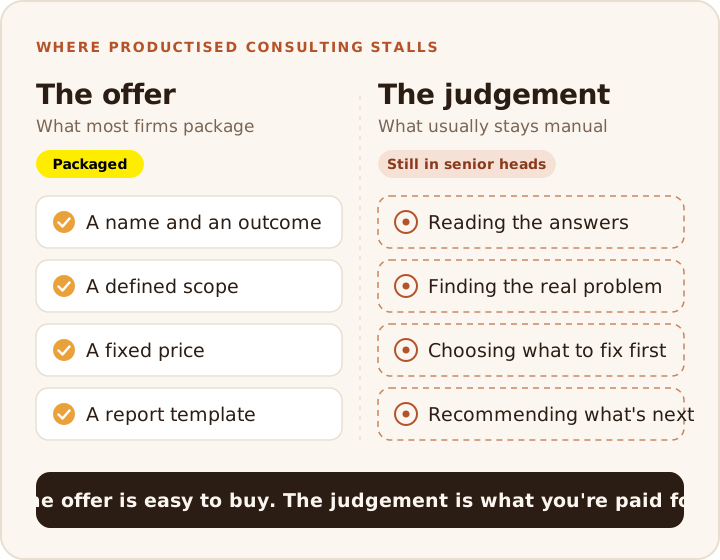
That first read is where the time goes, and the front of the funnel pays for it. A prospect has to get a meeting before they learn anything. They fill in a form, wait for a call, and only get real insight once a consultant has time. Many never make it that far.
What AI changes
A static questionnaire can collect answers. It can't interpret them. AI can. If you write down how you think (the questions you ask, the follow-ups you'd ask next, how you weigh the answers, what you'd recommend in each case), AI can apply that reasoning to every prospect who comes through the door.
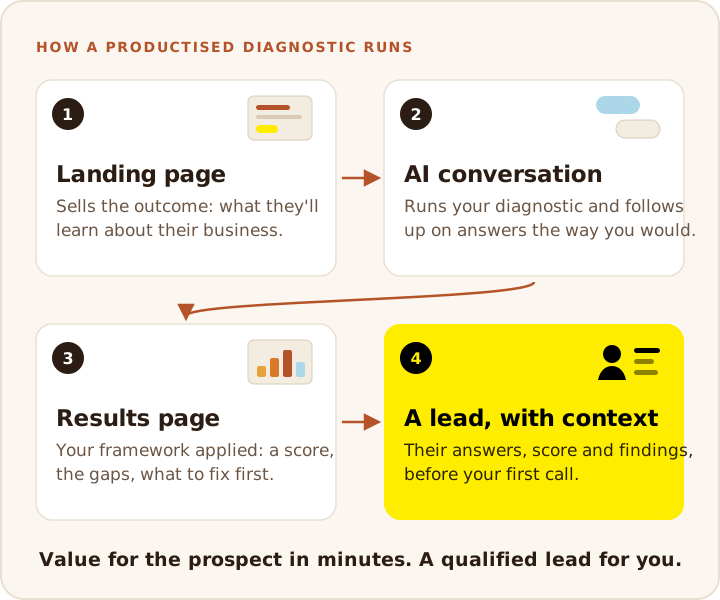
So your diagnostic can become an AI-powered product:
- A landing page that sells the outcome: what the prospect will learn about their business.
- An AI conversation that runs your diagnostic, follows up on vague answers the way you would, and adapts to what it hears.
- A personalised results page that applies your framework: a score, the gaps that matter most, what to do first, and where you can help.
Two ways to use AI in a consultancy
Once your method can run on AI, you have a choice about where to put it.
Inside the firm. The AI becomes a tool for your consultants. They run each assessment for a client or prospect, review the reading, and bring it to the pitch or the delivery. You pay per seat, delivery gets faster and more consistent, and you get evidence to defend your fees.
That's a real improvement, but look at what hasn't changed:
- The prospect still needs a meeting first. Nobody sees your thinking until a consultant has made time for them.
- Every prospect still costs consultant time. Faster, yes. But someone still runs it, reviews it and presents it, including for prospects who were never going to buy.
- It only reaches people already talking to you. It makes your existing pipeline more efficient. It doesn't create one.
At the front door. The AI becomes something your buyers use themselves. It's live at a link, on your website, in your LinkedIn posts and your emails. A prospect runs it whenever they're ready, at 10pm on a Sunday if they like, and gets a real answer straight away. You get a lead with their answers, score and findings attached.
- Value comes before the meeting, not after it.
- Consultant time starts at the call, with prospects who already understand their problem and why you can help.
- It finds people you'd never have met. Most buyers research quietly long before they book anything. Now they can research with you.
The first approach makes consultants faster. The second brings them better conversations. And because the AI does the work, there's no reason to charge for it.
Don't make the AI part the product
The natural next step for many firms is to sell what the AI produces: a paid assessment, a subscription to ongoing measurement, fees linked to the scores it reports. In most cases that's a mistake:
- Buyers can tell what it is. Once a client knows a report took an AI fifteen minutes, a consulting-sized price looks like a mark-up on software, not payment for expertise.
- It puts a toll booth at the front door. The diagnostic is your best way to start a relationship. Charging for it adds friction exactly where you need the least.
- It ties your price to the cheapest part of your work. If clients learn your expertise comes out of an automated report, they start valuing all of it that way.
- Someone else will give it away. Assessments get cheaper to build every month. A competitor's free version, better presented, makes yours look expensive.
- It sells the scoreboard, not the win. A score tells a client where they stand. What they actually want is the change, and that still needs a person who can lead it.
An AI diagnostic tells a client what's wrong. A consultant is how it gets fixed. Charge for the second one.
Outcome-linked pricing isn't the problem here. If you want to price on results, price the engagement that produces them. Just don't make the measurement the thing you sell.
Where the value actually lies
Clients don't hire consultancies for questionnaires. They hire them for judgement in context: the senior person who sees what the data doesn't show, challenges the leadership team, earns their trust and takes them through the change.
That happens in the meeting, the workshop and the engagement. Everything before it has one job: getting the right people there already convinced you understand their problem.
A free AI diagnostic does that better than anything else. The prospect arrives having seen your thinking applied to their own business. They've had a real answer, not a teaser. You know their answers, their score and what the AI found before you say hello. The first call starts where a discovery call usually ends, and the proposal almost writes itself.
The diagnostic isn't the product. It's the stepping stone to the consultant, and the consultant is the product.
Give it away, then give away more
Once the diagnostic is free, stop treating it as a one-off. Build free, genuinely useful AI-powered products for every stage of the client relationship, each one a reason to keep talking.
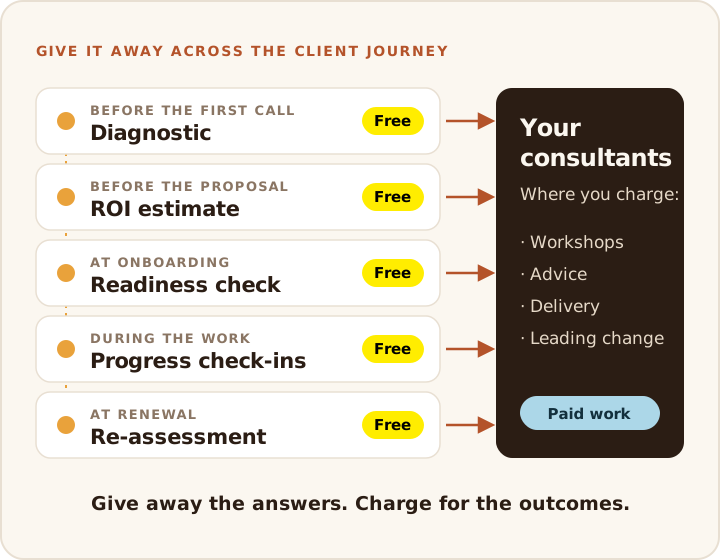
- Before the first call: a diagnostic. Shows the prospect where they stand and why it matters. Earns the meeting.
- Before the proposal: a cost-of-inaction or ROI estimate. Puts numbers on the problem in the client's own terms, so the fee is easy to justify internally.
- At onboarding: a readiness check. Surfaces blockers before day one and makes the first workshop sharper.
- During the work: progress check-ins. Short re-runs that show the client what has moved, so the value stays visible between meetings.
- At renewal: a re-assessment. Compares today with the baseline. The best case for the next phase is the client's own improvement.
- For referrals: a shareable version. A happy client sends it to a peer, and the next relationship starts the same way.
That's the same baseline, diagnose and remeasure loop the inward-facing platforms sell to consultancies. The difference is who holds it. Here the client runs it, sees it and shares it, and every run is a reason to talk to you. None of it is billable. All of it makes the billable work easier to win, deliver and renew.
How to productise your consulting judgement
You don't need an operating system or a maturity model to start. You need one diagnostic, live at a link.
1. Pick the diagnostic you repeat most
Look for the first conversation you have with nearly every client: the readiness check, the health check, the "where are you now" review. If you could deliver it in your sleep, it's the right one to start with.
2. Write down the questions and the follow-ups
Not just the questionnaire. Write down what you ask next when an answer is vague, worrying or surprising. That branching is where your expertise lives, and it's exactly what a static form loses.
3. Make the interpretation explicit
For each area you assess, describe what good, average and poor look like, and what you'd recommend at each level. If two consultants at your firm would read the same answers differently, settle that now. AI doesn't fix weak thinking. It just repeats it faster.
4. Give a real answer, not a teaser
A results page that says "book a call to find out" wastes the prospect's time and your credibility. Give them the score, the gaps and the first thing to fix. Generosity is what makes the call feel like the obvious next step.
5. Make the meeting the next step
Decide which results lead to a call, what your team needs to know before they pick up the phone, and how the conversation picks up where the results page left off.
What this looks like on Productised
Productised is built for the front-door approach: AI-powered products that win clients, not ones you bill them for. You describe your diagnostic to Claude, and it builds the whole thing: the landing page, the conversation that runs your method, and a branded results page that turns each prospect's answers into a personalised outcome. It goes live at a link you can share, embed on your site or put on your own domain.
Every completed run becomes a lead with the full picture attached: their answers, their score and what the AI found. Your prospects never pay a thing, no consultant has to run it, and your team walks into every first call already knowing the problem.
A few consulting products firms build this way:
- Operations readiness scorecard. Scores a business across people, process, systems and data, then gives a prioritised improvement plan.
- Pricing health check. Spots margin leaks and under-pricing, and points to the fix with the biggest impact.
- AI readiness assessment. Shows where a company actually stands on AI adoption and what to do first.
- Growth audit. Diagnoses whether the bottleneck is positioning, pipeline or conversion.
You can start from one of the ready-made templates or build your own method from scratch with the Claude connector.
Mistakes to avoid
- Charging for the diagnostic. It's the cheapest part of your work for AI to produce and the most valuable for starting relationships. Treat it as marketing, which means free.
- Keeping it behind a meeting. If a consultant has to run it before anyone sees a result, you've made delivery faster but left the front door shut.
- Productising everything at once. One strong diagnostic beats five average ones. Add products across the journey once the first one is working.
- Hiding the value until the sales call. Give prospects a real answer. The call should feel like the next step, not a ransom.
- Treating the method as finished. Read the results your product produces. Where they're wrong or thin, sharpen the logic.
Frequently asked questions
What is productised consulting?
Productised consulting is packaging advisory work into a defined, repeatable offer with a fixed scope, a fixed price and a standard method, instead of scoping every engagement from scratch.
Should consultants charge for AI-powered assessments?
In most cases, no. An AI assessment costs very little to run and is the best way to start a client relationship. Charging for it adds friction at the front of your funnel and ties your price to automated work. Give it away, use it to qualify and warm up leads, and charge for the consulting that follows.
Should the AI diagnostic be run by consultants or by the client?
For winning work, by the client. A self-serve diagnostic reaches prospects before they're ready to talk, costs no consultant time, and hands you a qualified lead. Consultant-run assessments still have a place inside an engagement, but they can't open doors that are still closed.
Does a free diagnostic devalue my expertise?
The opposite. A generous, useful result proves you know what you're talking about before the prospect has spent anything. What you charge for, the judgement, the relationship and the delivery, stays exactly where it was.
Isn't outcome-linked pricing the future of consulting?
It may well be, for the engagement. Price the change you deliver, not the report that measures it. The measurement works far harder as a free product your client can run again and again.
Where should a consultancy start?
With the diagnostic you already run at the start of most engagements. Build it as a free AI-powered product, put it in front of prospects, and let it earn you better first calls.
AI can now do the part of consulting that used to slow everything down: the first read of a client's situation. You can lock that inside the firm, or turn it into another invoice. Or you can give it away, make it brilliant, and let it bring the right clients to the people who can actually help them.
Want to see what a free consulting diagnostic looks like? Browse the templates, or build your own in an afternoon.
Turn your expertise into a branded AI product
Productised gives your knowledge a shareable link, captures every lead, and delivers personalised value before the first call.
Get Started →