

Having a conversation
How to get the most from a Brain session — what to say, what context to give, and how to turn a conversation into a build-ready concept.
Brain works best when you treat it like a well-briefed practice strategist who already understands the coaching and consulting market. The more you give it, the more precise and actionable it gets. Come in with context. Be specific about what you're trying to solve. Remember you can also invoke the Brain through our Claude connector! So you don't have to switch between applications.
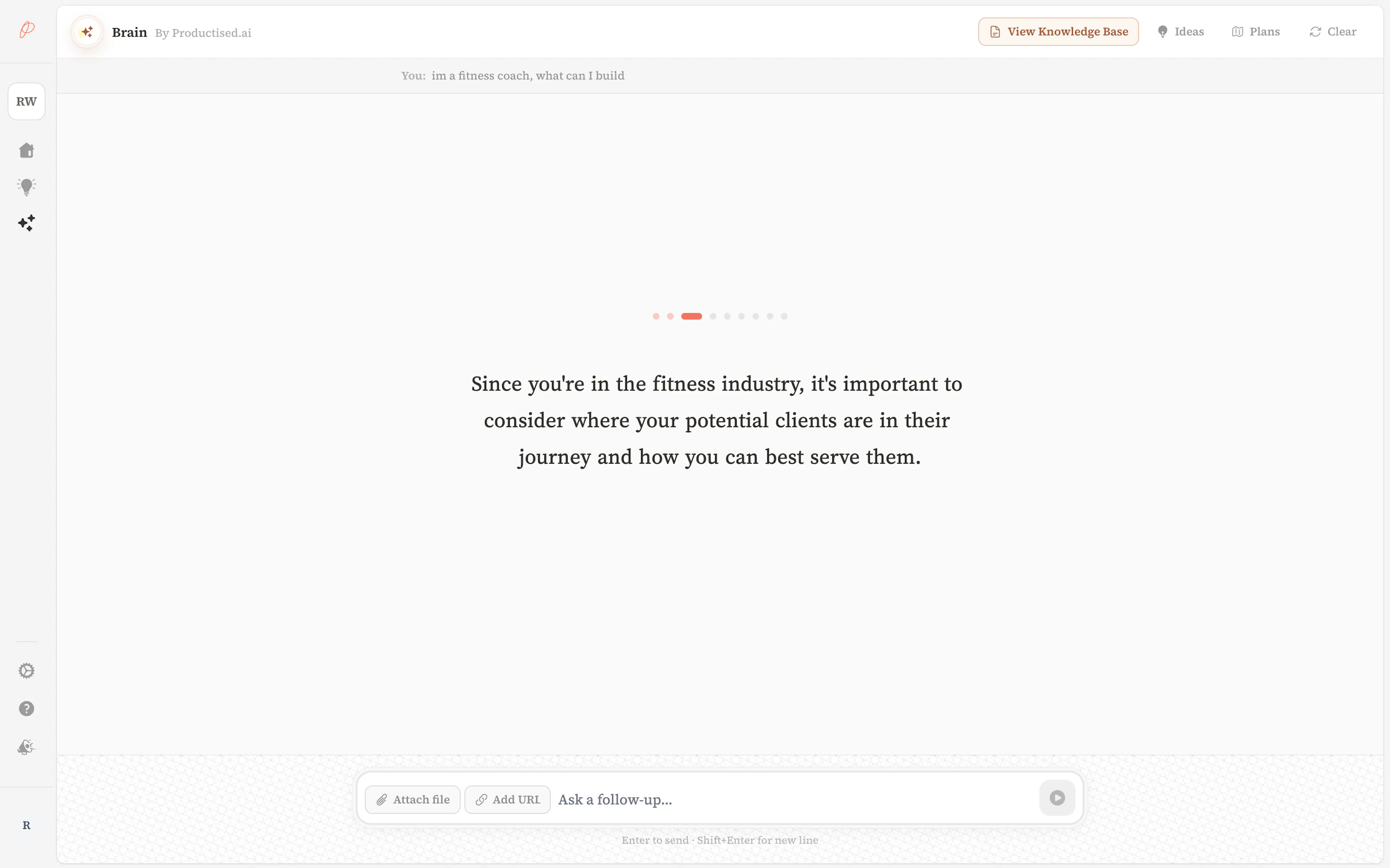
What makes a great Brain conversation
The coaches and consultants who get the most from Brain do a few things consistently.
They describe their audience with precision — not category. Not "coaches" — "leadership coaches who work with mid-career professionals transitioning into senior roles at FTSE 500 companies." Not "consultants" — "organisational psychologists advising companies through post-merger culture integration." The tighter your niche, the more targeted the product recommendation. Brain can work with specificity in a way that generic strategy advice cannot.
They share what they already have. Brain knows your existing products and actively uses that context to spot funnel gaps rather than suggesting things you've already built. Tell it explicitly: "I have a ToFU diagnostic and a high-ticket retainer, but nothing in between." That framing produces a categorically different recommendation than asking what to build without context.
They bring the problem, not just the idea. "I want to build a scorecard" is a solution. "I've got a lot of people at the top of my funnel who aren't converting and I don't know what's filtering them out" is a problem. Brain can work backwards from problems. It will surface the product type and approach that actually addresses the underlying issue — not just the first product type that matches the word "scorecard."
They share their methodology. If you've developed a proprietary framework — a signature process, a diagnostic model, a set of principles you use with every client — tell Brain. This is often the most valuable context you can give. Brain will work out how to productise your intellectual property specifically, not just suggest generic coaching products.
They ask follow-up questions. A great Brain session builds on itself. If a concept looks right but the framing is off, say so. Brain adjusts. Push it until the recommendation feels exactly right for your market.
Give Brain a quick briefing at the start of a new conversation — who your audience is precisely, what you already have, and what problem you're trying to solve. A 60-second setup saves ten minutes of back-and-forth and produces recommendations that are immediately usable.
Starting a new conversation vs continuing one
Each conversation in Brain is a session. Previous sessions are saved and accessible in the left panel — you can return to any past conversation and pick up where you left off.
Start a new conversation when you're exploring a fresh strategic question or a different part of your product range. Continue an existing conversation when you're building on a previous thread — refining an idea Brain surfaced, going deeper on a concept, or revisiting a recommendation with new context.
Brain's memory system means even new conversations benefit from what previous sessions established. If you told Brain three sessions ago that you work exclusively with senior leaders in the professional services sector and never take on early-stage founders, that preference is still alive in the next conversation. You don't repeat yourself.
What Brain will push back on
Brain is designed to be useful, not agreeable. It will occasionally ask for more context before committing to a recommendation. It will flag when an idea sounds like something that's already saturated in your niche. It will point out when a product concept doesn't fit cleanly into a funnel stage — and explain what that means for how you'd promote it.
This is by design. A coaching business that builds the right three products will outperform one that builds fifteen mediocre ones. Brain's job is to get the selection right, and that sometimes means slowing down to make sure the foundation is correct before generating a BUILD_THIS card.
BUILD_THIS cards only appear when Brain is confident enough to make a specific recommendation. If the conversation is still exploratory, Brain will ask more questions before committing to a card. That's intentional — a premature recommendation is worse than a well-reasoned one delivered two minutes later.
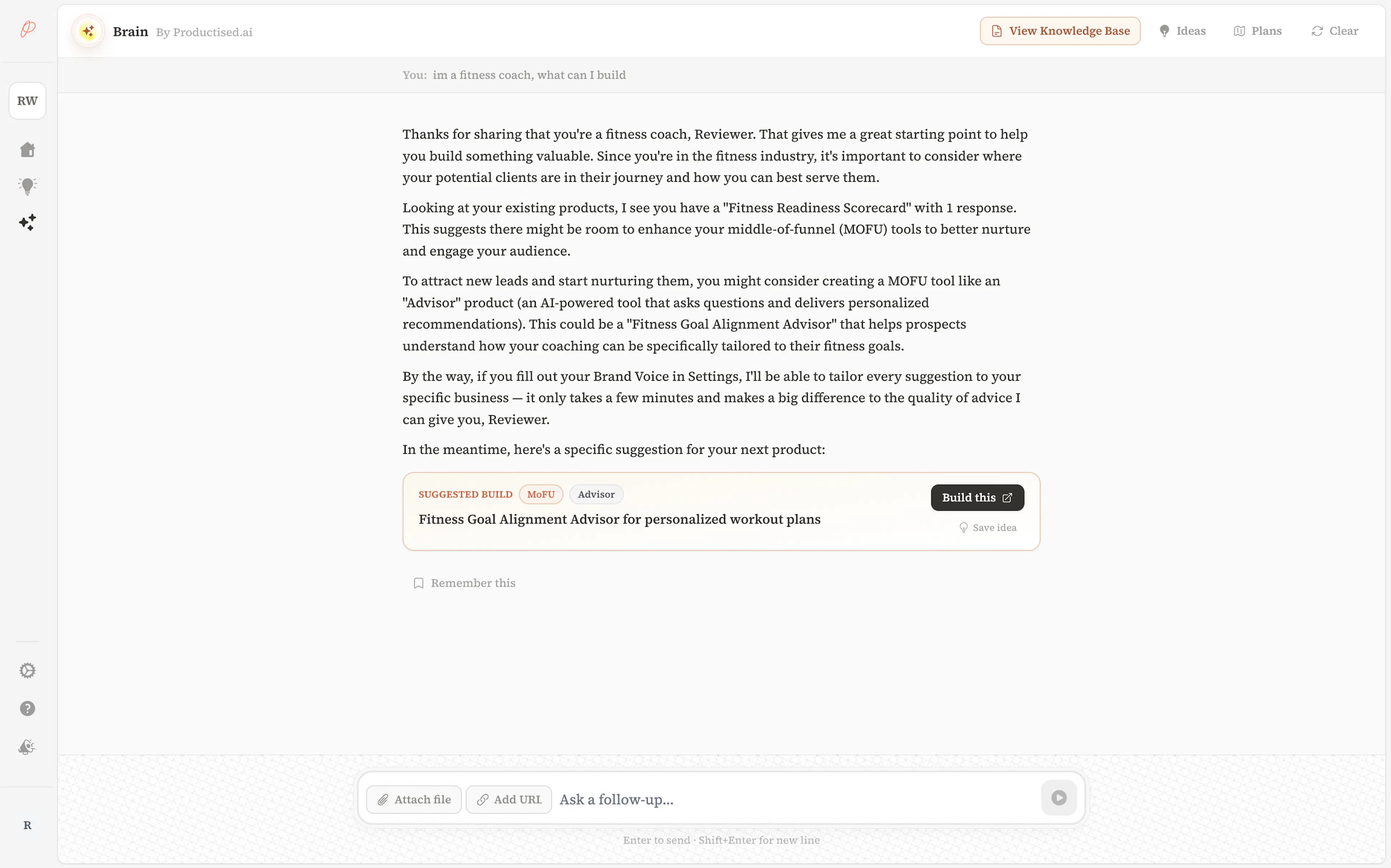
How BUILD_THIS cards work
When Brain has enough context to make a confident, specific recommendation, it generates a BUILD_THIS card inline in the conversation. This isn't a vague suggestion — it's a complete concept: a product name, an output type (Standard, Page, Advisor, Collect only), and a funnel stage.
Clicking the BUILD_THIS card opens the canvas with that concept pre-loaded. The product name, output type, and funnel stage are already configured. You're not starting from a blank canvas — you're starting from Brain's recommendation, ready to build.
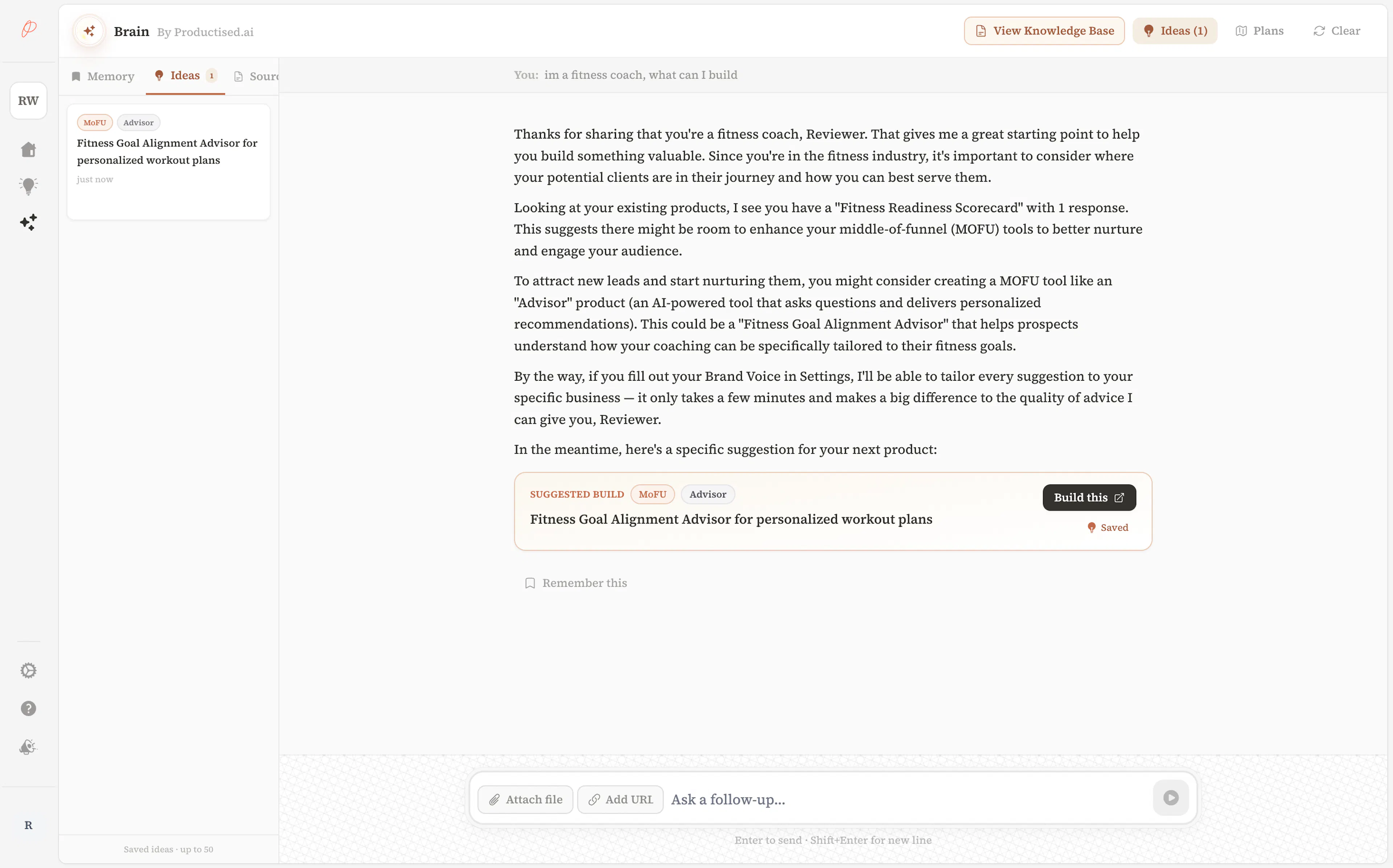
The concept is also saved to your Ideas tab automatically, so it's there whenever you're ready to build — even if you come back tomorrow.
Conversation limits by tier
| Plan | Conversations per month |
|---|---|
| Starter | 5 |
| Pro | Unlimited |
Conversations reset at the start of each billing month. Continuing an existing conversation does not count against your limit — only starting a new one does.