

Product ideas
Your Brain-curated product backlog — concepts surfaced through strategic conversations and ready to build the moment you are.
Brain doesn't just advise — it recommends. When a conversation reaches the point where Brain is confident enough to suggest a specific product, it generates a concept and saves it. Those saved concepts live in the Ideas tab of the left panel.
Think of it as your product backlog — except instead of being populated with half-baked ideas from late-night brainstorming sessions, it's populated by your strategic advisor, who knows your niche, your existing products, and your funnel gaps.
How ideas are created
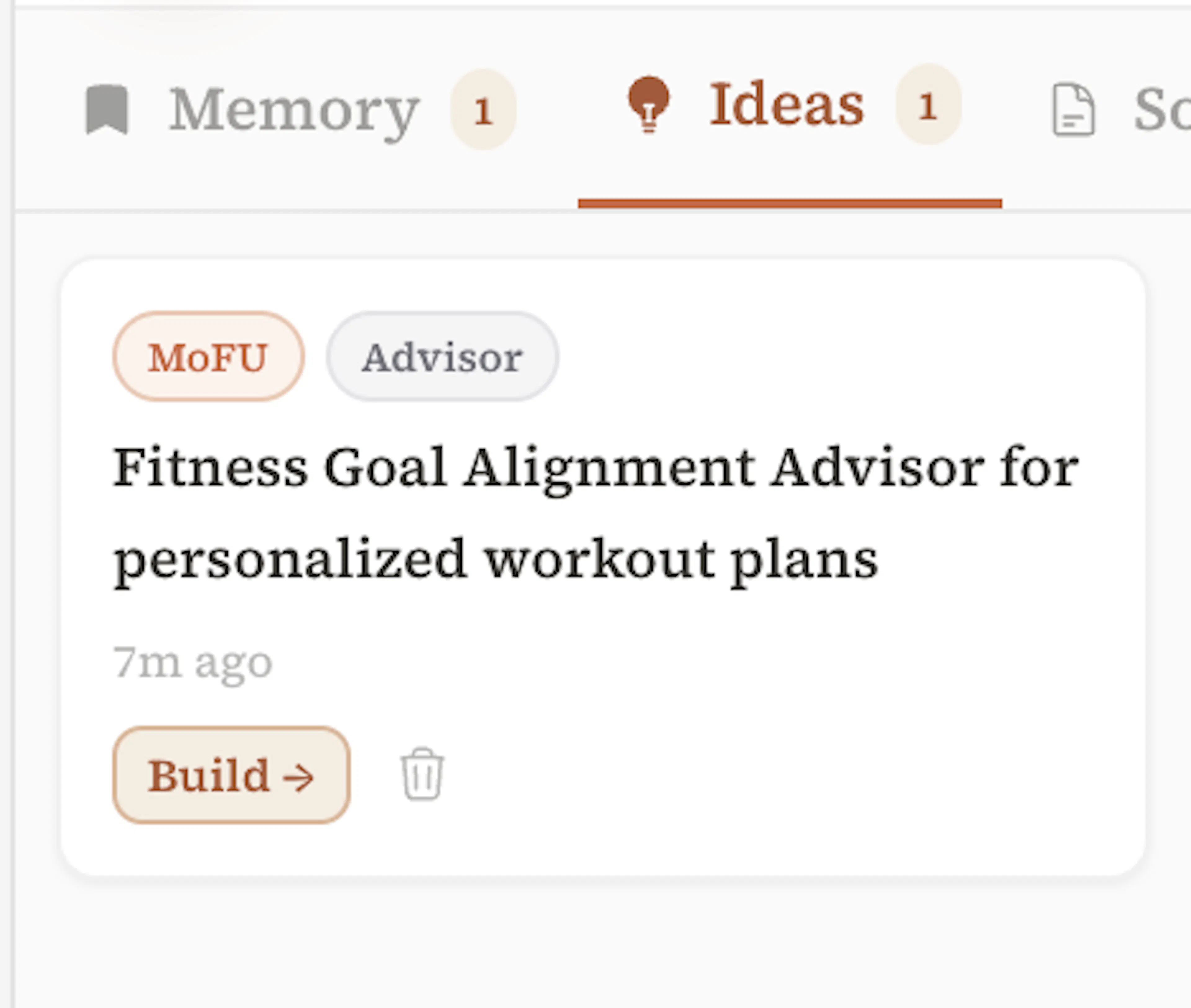
Ideas appear when Brain generates a BUILD_THIS card during a conversation. The moment Brain makes a confident, specific recommendation, it saves the concept to your Ideas tab automatically. You don't need to capture it, copy it, or do anything — it's already there.
Each idea card shows:
-
Output type — the Productised outcome (Standard, Page, Advisor, Collect only)
-
Funnel stage — where this product sits in your funnel (ToFU, MoFU, or BoFU)
-
Concept description — what the product does, who it's for, and what makes it the right fit for your positioning
You can also save ideas directly from your Journey Plan — the full-funnel product roadmap Brain can generate from your accumulated context. Any product recommendation in the plan can be added to your Ideas backlog with a single click.
Taking an idea to the canvas
When you're ready to build, click the idea card. This opens the canvas with the concept pre-configured — the product name, output type, and funnel stage are already set. You're not starting from scratch. You're starting from Brain's recommendation.
From there, the canvas AI assistant (Quick Generate) can help you build out the rest: the conversation structure, the collection questions, the system prompt, and the output format. The strategy is done. Now you build.
If you have an idea you want to sharpen before building, take it back to Brain. Paste the concept into a conversation and ask Brain to help you refine the name, positioning, funnel placement, or output type. Brain can stress-test an idea as readily as it can generate one — and a refined concept often becomes a significantly better product.
How Brain avoids duplication
Brain knows what you've already built on Productised. When it makes recommendations, it takes your existing products into account — it won't suggest a product that closely mirrors something you already have.
More usefully, it actively looks for funnel gaps. If you have a strong ToFU product and a BoFU offer but nothing in the middle, Brain will notice. It will suggest MoFU products that bridge the two — products that educate, build trust, and move prospects closer to a buying decision without asking for commitment prematurely. This is where most coaching businesses are weakest, and Brain will consistently point you toward it.
Your existing product range isn't just background context for Brain. It's a direct input to its recommendations.
Bringing your own ideas
You don't have to wait for Brain to surface a concept. If you already have an idea — even a rough one — tell Brain and ask it to sharpen it. Brain can help you with:
-
Naming — what to call it, and how to frame it so it lands immediately with your specific audience
-
Positioning — how to describe it in a way that's compelling without overpromising
-
Funnel placement — whether it belongs at the top, middle, or bottom of your funnel, and what that means for how you promote it
-
Output type — which Productised product type is the right vehicle for what you're trying to deliver
A good idea, refined by Brain, almost always becomes a better one. Use it as a strategic sounding board, not just a generator.
Your Ideas tab as a strategic asset
Over time, your Ideas tab becomes one of the most valuable things in your workspace. It's a record of every concept Brain has surfaced and refined in your conversations — a curated backlog of products that are specifically designed for your niche and aligned with your funnel.
When you're thinking about what to build next quarter, this is where you start — not a blank page, but a list of concepts that have already been strategically validated for your practice.